
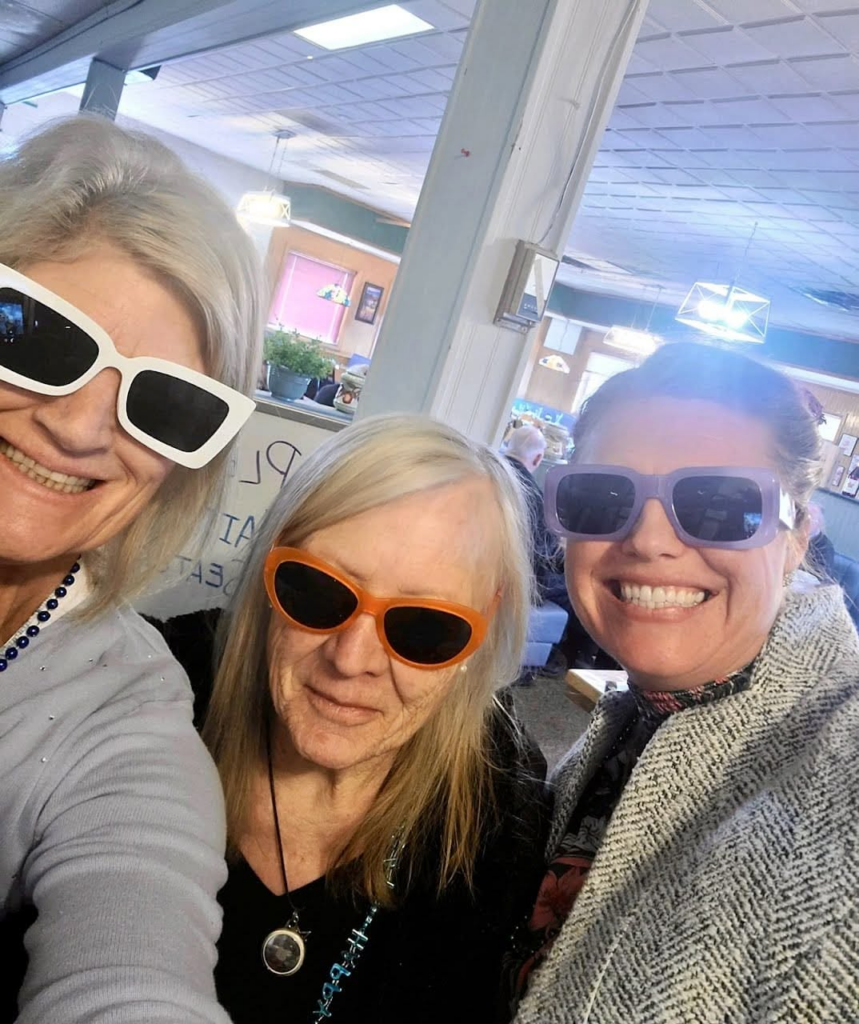
Hi AWG Team!
I love this picture of one of our caregivers having fun with her client and the client’s daughter!
There have been many of you that have and are struggling with life challenges, we want you to know we pray for you. And in the midst of your challenges many of you have stepped up to help cover when someone else was handling a personal challenge. Thank you for caring for eachother in this way!
We have received continued referrals from our clients who love Age With Grace (AWG)! It takes all of us to make our agency great. Thank you for being a part of this AWG family!
I really enjoyed this article from Dawn and how her DAWN theory was born. Try her suggestion to verbalize your rational thoughts like the steps you are taking to help someone dress or prepare to leave, or brush teeth, etc. Notice if it helps them to feel calmer and safer.From Dawn…
The article I’m sharing today is about how we lose rational thought in dementia, but never lose our intuitive thought, and it’s our intuitive thinking that gives us the ability to enjoy life.
Why DAWN Explains the Loss of Rational Thought
Dementia came into my life as it does for many of us—when someone we love begins to experience it. For me, it was a neighbor who had been diagnosed with Alzheimer’s and was becoming too forgetful to manage on her own. Her children lived elsewhere and would need to move her into a care facility unless they could find someone to check on her and help her with errands. I had just moved to Moscow and wasn’t working yet, so I volunteered. I didn’t want her to be forced to leave her home of many years just because she was becoming forgetful and confused.
Within a few months I was helping half a dozen seniors who were living on their own with mild cognitive impairment or dementia. They were all very different people—they had been housewives, professors, ranchers, business owners and scientists in their earlier lives. But they all needed help and were all experiencing emotional distress. During that first year, I kept looking for a pattern that was common to them all, a pattern in what they could and couldn’t do, so that I could anticipate their needs and keep them safe without embarrassing or disempowering them—and be able to teach my staff to do the same.
And, I was very aware of their emotional distress. I could see them bewildered by not being able to succeed at simple tasks that they’d never had trouble with before. I knew that I’d experienced something like that at one point in my life, but I just couldn’t put my finger on it. Then one day it hit me: My clients were grappling with what I faced when I started attending law school. Like I was then, they were finding that the skills that had always worked for them in the past no longer brought success.
The discomfort of losing rational thought processes to dementia or Alzheimer’s
During my younger years my studies and work were all more creative than analytical. I had studied art and music as a child, then literature and language. I had worked in marketing, graphic design, and writing, as well as in supportive and development roles with people who had cognitive impairments. I was adept at using my intuitive thinking skills for expressing and exploring and creating. Then, as an older adult I won a scholarship to attend law school, where I was required to use my memory skills and analytical thought processes rather than intuition and creativity. It was very unpleasant for me until I developed my rational thinking skills.
When I remembered my own discomfort at being forced to use my rational thought processes exclusively, I realized that I was watching my dementia clients go through the same experience, only in reverse. My clients were losing their rational thought processes and being forced to navigate daily life with intuitive thought alone.
We can express rational thought processes for them
This realization dramatically changed my life as a care partner—and the lives of my clients. I began expressing my own rational thought processes out loud, for them. I began reciting facts, outlining steps and events, drawing conclusions—and they began to relax and feel safe. Once they felt safe with me because I was expressing my rational thought on their behalf, our times together became joyful. They weren’t constantly put on the spot, constantly failing. So together we could savor all that our intuitive thought processes make available to us: beauty, companionship, laughter, and feelings.
Recognizing this pattern in the experience of dementia is the basis of the DAWN Method. It teaches us to recognize our two distinctly different sets of thinking skills, first in ourselves and then in our companions. We come to understand that each provides us with a distinct set of tools, and benefits. We accept that dementia takes away not just our memory skills, but our rational thought processes—such as the ability to apply facts, follow a sequence, or see cause and effect—but it doesn’t take away our intuitive thought processes, the skills that enable us to enjoy life. When our care partners take care of the rational thought functions for us, and stop expecting us to do so ourselves, we can continue to experience the best things in life: beauty, companionship and feelings—what our senses bring to us in the present.
This is the core of the DAWN Method. It is the understanding that we can use our memory skills and our rational thinking skills on behalf of our loved ones and clients, and bring what they find beautiful into their lives, so we can enjoy life together. Dementia needn’t include tragedy alone. It just needs care partners to understand which skills are lost so they can provide empowering support.